Health Intelligent and Interoperability Platform

"Architecture is alignment: of standards, of teams, and of the data a clinician can actually use."
Overview
Project: Health Intelligent and Interoperability Platform (HIP) Role: Solution Architect and Forward Deployed Engineer Employer: FPT Software, GHC.DHM Site: fptghc.com Status: In market
I designed this AI-powered health data platform end to end, took it into bids, and built it fullstack across data, AI, and application. I also led the team that proposed it to the customer, in the room as Forward Deployed Engineer and Solution Architect.
The public site is the platform landscape. Clinical sources land on one interoperable backbone, and accelerator products sit on top of it.
What the platform does
HIP connects healthcare data through open standards such as FHIR and HL7, then puts governed data and AI to work. It runs on Microsoft Azure, AWS, GCP, and FPT Cloud, and can be delivered as SaaS, in a customer VPC, or on-premise.
| Layer | What it covers |
|---|---|
| Sources | EHR and HIS, labs and imaging, claims and ERP |
| Backbone | A healthcare standard data model, transformation, observability, governance, and security |
| Use | Command-centre dashboards, embedded machine learning, and a clinical AI assistant on the data |
The accelerator products are how a customer gets a specific outcome without waiting for a greenfield build.
Products on the platform
Mapwise
AI-powered data integration and interoperability. mapwise.fptghc.com
Mapwise connects databases, files, and APIs, then maps them to FHIR R4, OMOP CDM, or a custom target schema. AI suggests fields and confidence scores. A second workflow matches and merges records across two feeds: blocking and matching rules, review queues, a surviving value per field, and an approval trail.
It is the product I point to when a bid needs "connect these systems to a standard model" instead of a months-long mapping project in spreadsheets.
AnonyMinds
AI-powered data privacy. anonyminds.fptghc.com
AnonyMinds detects PII and PHI in text, images, and structured data, then masks, tokenizes, hashes, or anonymizes. The pipeline can run in flight while data is cloned into a lake or a sandbox, so analytics and model training do not sit on raw patient identifiers. The controls are aimed at HIPAA, GDPR, and CCPA.
MediCoder
AI-assisted medical coding. medicoder.fptghc.com
MediCoder takes clinical documentation to final codes across ICD-10-CM, ICD-10-PCS, and ICD-9-CM. Suggestions are ranked with confidence, each code ties back to a span in the source note, and the case keeps an audit trail for coder, supervisor, and compliance review. Coders can accept, reject, or add a code. The model does not lock the chart by itself.
How I worked it
The same engagement covered design, the bid, the build, and the customer proposal.
- Solution design. Reference architecture, standards (FHIR, HL7, OMOP), security boundaries, and the deployment shapes a buyer can actually procure.
- Bidding. The narrative, the architecture, and the proposal the customer evaluated.
- Build. Data platform, AI accelerators, and the applications around them. Not a slide-only architecture.
- Customer proposal. I led the team in front of the customer as Forward Deployed Engineer and Solution Architect.
Azure reference architecture
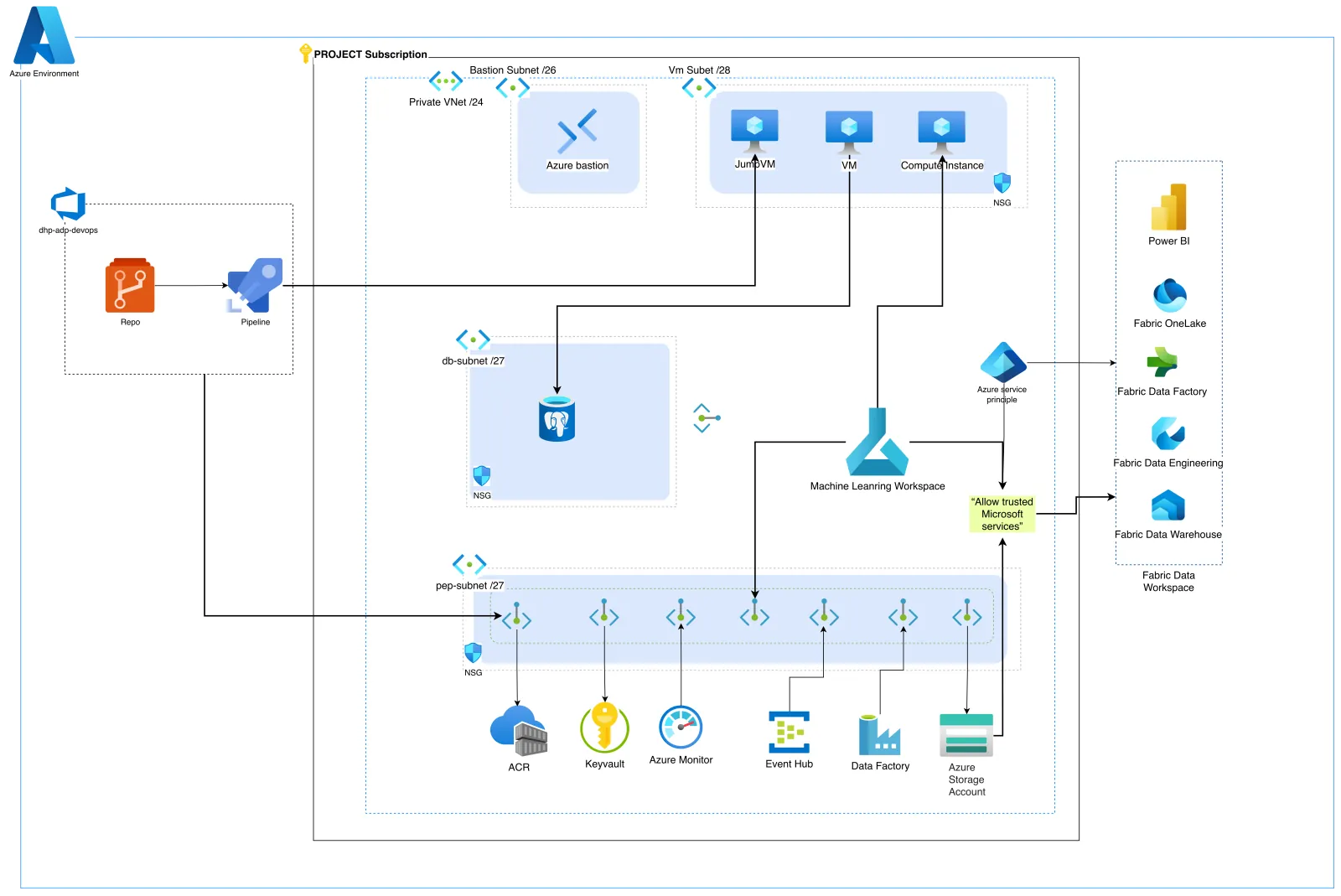
One deployment of this platform is Flexzi HIP on Microsoft Azure, listed on Microsoft Marketplace. The diagram below is the landing zone I designed for that offer: private networking, a Fabric lakehouse, and room for machine learning.
What is on the diagram
- Access. Azure Bastion, a private VNet, network security groups, and private endpoints. No public IP as the way in.
- Data. Azure Data Factory, a storage account for the lake, Key Vault, and Container Registry.
- Fabric. OneLake, Data Factory, Spark engineering, a warehouse, and Power BI.
- AI. Azure Machine Learning for training, plus accelerators on Azure Kubernetes Service and Azure AI Foundry.
- Operations. Azure Monitor and Event Hub. Platform networking and resources are defined in Bicep.
Security by design
| Layer | Implementation |
|---|---|
| Network isolation | Services talk over private endpoints inside the VNet |
| Access | Bastion for administration, without exposing a public IP |
| Secrets and keys | Azure Key Vault |
| Healthcare compliance | Shaped for HIPAA and HITRUST expectations |
Reflection
HIP is the piece of work where architecture, the bid, and the product are the same job. The platform is the interoperable backbone. Mapwise, AnonyMinds, and MediCoder are how that backbone shows up as something a hospital, a payer, or a research team can deploy.
"A standard model only matters if a team can map to it, protect it, and code from it."
© 2026 Kato (Quan Ngo), Solution Architect, GHC.DHM at FPT Software